|
Stainless steel has the advantage of not rusting. Then why is stainless steel not chosen as the material for the main shaft of a centrifugal pump?
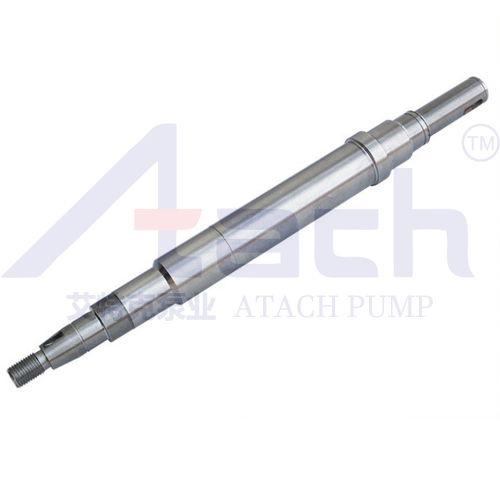
In the selection process of ATACH Pump Industry, sometimes customers will write stainless steel 304 in the material requirement column for the shaft. The technicians of ATACH Pump Industry usually suggest that customers change the material of this item. The reasons and analysis are as follows: Stainless steel is indeed renowned for its excellent corrosion resistance (i.e., the "rust-free" property), but the main shafts of centrifugal pumps are not often made of stainless steel. This is mainly based on a comprehensive consideration of material performance, cost, and actual working conditions. The following is an analysis of the reasons from several key perspectives 1.The mechanical strength and wear resistance of are insufficient When the stainless steel spindle is subjected to high torque and high-speed rotation, it may be prone to deformation or wear due to insufficient strength or hardness. The main shaft of a centrifugal pump needs to transmit power and maintain high concentricity. The mechanical properties of ordinary stainless steel (such as tensile strength and fatigue strength) may not meet the requirements of heavy-load working conditions, while materials such as alloy steel or tool steel have more advantages. 2. Trade-off between cost and economy Stainless steel materials are relatively expensive, especially for large pump bodies or high-precision shaft components. If the main shaft is made of stainless steel, it will significantly increase the overall manufacturing cost, and its corrosion resistance advantage in the shaft components (usually protected by seals) may not be fully utilized. The use of ordinary steel in combination with surface treatments (such as chromium plating and nitriding) can reduce costs while meeting usage requirements. 3. The particularity of the corrosive environment Although stainless steel is corrosion-resistant, the working environment of the main shaft may involve friction and wear, insufficient lubrication or local stress concentration. These factors may damage the passive film on the surface of the stainless steel, leading to pitting or crevices corrosion. In corrosive media containing chloride ions, stainless steel spindles may still rust (as described in data 4), while dedicated corrosion-resistant alloys or coatings can provide more reliable protection. 4. Design and maintenance convenience The main shaft of centrifugal pumps often need to be precisely fitted with components such as bearings and couplings. The processing difficulty and heat treatment characteristics of stainless steel may increase the manufacturing complexity. In contrast, standard steel is easier to process, its hardness is controllable after heat treatment, and it is more convenient to replace and maintain. 5. Maturity of the alternative to In industrial practice, high-quality carbon steel or alloy steel is often used for spindles, and their corrosion resistance is enhanced through surface hardening techniques such as nitriding and nickel plating. Such solutions are cost-effective and highly reliable. Stainless steel or duplex steel spindles will only be considered in extremely corrosive environments (such as strong acids and high chloride ion media), but the specific working conditions need to be evaluated. In conclusion, when choosing the material for the main shaft of a centrifugal pump, mechanical properties, cost and actual working conditions should be given priority, rather than relying solely on the corrosion resistance of stainless steel. For further understanding of material selection under specific working conditions, targeted analysis can be conducted by referring to the pump's usage environment (such as medium composition, temperature and pressure). |